Newspaper reports
Native SonNewspaper reports are a recurring object in Native Son and a force in the novel’s public world: they transform a private crime into a citywide spectacle, announce the pursuit of Bigger Thomas, and frame him through racialized claims that outrun what the evidence establishes. For Bigger, the papers are at once information, threat, and an account of a life that seems to become publicly visible only after he acts. Their changing headlines trace the case, but their distortions also reveal how journalism can turn uncertainty into a license for collective punishment.
From disappearance to public scandal
When the investigators go upstairs at the Dalton home, Bigger is left alone with a newspaper. He checks that the door is locked, looks toward the kitchen, then takes the paper and reads its prominent account of Mary Dalton’s disappearance. The headline links her absence to Communists, and the article presents Jan Erlone as a suspect because of his association with the Labor Defenders and Mary’s reported membership in the Communist movement. A photograph of Jan appears on the front page. The story situates the disappearance in a conflict between Mary’s wealthy family and her supposed political sympathies, while reporting that Jan is being held for investigation at the Eleventh Street Police Station.
The paper also places Mary in the company of Jan at a South Side café in the Black Belt. Its account prompts Bigger to look again at her photograph, which recalls her death to him; the newspaper’s ordinary image and his private knowledge cannot be reconciled. He fears that the story will lead people to suspect kidnapping, but at this point its account has not yet exposed what happened. The scene establishes a central tension in the object’s role: readers encounter a developing public narrative, while Bigger reads it under the pressure of what he knows and has concealed.
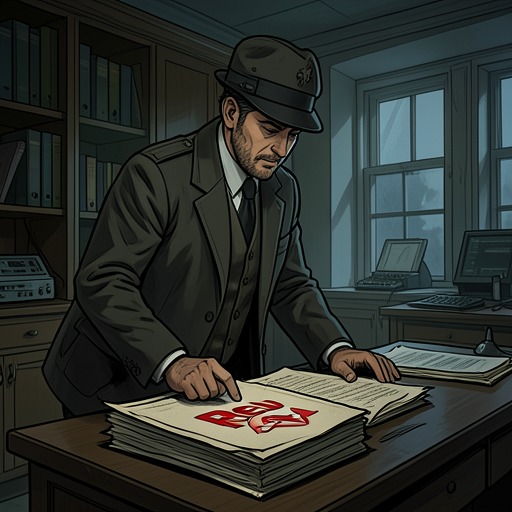
After the Dalton family’s ransom note becomes public, Bigger buys the Tribune for three cents and reads that the missing heiress’s abductors demand $10,000. The report identifies the note’s signature as Red and mentions its hammer and sickle emblem, presenting details that support the appearance of a Communist kidnapping. It also recounts the family’s demand that Jan be released and describes him as a Communist leader held in connection with Mary’s disappearance. The article’s account makes Bigger’s fabricated crime legible as a political conspiracy, while Jan’s arrest and the family’s request for his release become parts of the same public drama.
The changing account and the expanding search
As the case develops, the papers announce that reporters have found Mary’s bones in Dalton’s furnace and that the chauffeur has disappeared. The coverage shifts from a presumed kidnapping to an accusation that Bigger killed Mary and burned her body. It adds the claim that authorities suspect a sex crime, a suggestion that Bigger understands as effectively a sentence of death before capture. This is not a neutral clarification of the case: a conjecture is given public force by repetition and by its association with the missing white heiress.
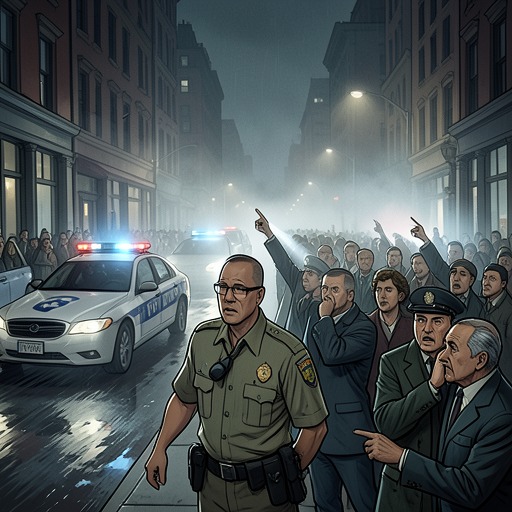
The articles accompany that accusation with a sweeping account of the response. One report says five thousand police have surrounded the Black Belt and describes volunteers, searches of homes, stops of vehicles leaving the South Side, and the rounding up of Black men for investigation. It reports broken windows, beatings, threatened school closures, vigilante offers of assistance, and Black employees dismissed from jobs. It also records a banker’s wife dismissing her Black cook out of fear. These details show how a report about one missing woman becomes a warrant for suspicion directed at a whole community; the purported search for one suspect produces consequences for people who have no established connection to the crime.
The maps make the search’s progress visible to Bigger in increasingly constricting form. In a later paper, the shaded search area has advanced from both north and south, leaving a small unshaded square in the middle of the Black Belt. The report states that eight thousand armed men have combed cellars, old buildings, and more than a thousand Black homes. For Bigger, the map is not simply a diagram: it translates the newspaper’s numbers into a shrinking space in which he believes he is waiting to be found. The coverage also notes that the building where he lived is owned and managed by a subsidiary of the Dalton Real Estate Company, tying the geography of his hiding place to the Daltons’ property interests.
Photographs, labels, and misrepresentation
Bigger repeatedly encounters his own likeness in print. On a streetcar he buys the Tribune and reads a banner declaring the heiress kidnapped and the abductors’ ransom demand. Later, after the discovery in the furnace, he reads a front page announcing the bones and the search for the missing chauffeur. The paper’s suggestion of a sex crime leads him to imagine the white readers accepting the allegation as proof of his guilt. The account’s effect is therefore not limited to describing the case: it shapes the danger he expects from strangers and intensifies his sense that the public has already decided what kind of person he is.
At a newsstand in the Black Belt, Bigger sees his picture centered on the front page and buys the Times while trying not to be recognized. Another report says that a 24-hour search has failed and that a raid has been made on one thousand Black homes; its map shows the white area of the search narrowing to a small space. The papers’ repeated use of Bigger’s picture and the escalating totals make his individual identity into a public emblem of threat. The reports also attribute a complex plot to a Communist accomplice, despite the absence of evidence against Jan. Reading this, Bigger wants to correct the story and clear Jan, but the newspaper’s allegation has already carried the authorities’ suspicions beyond what the facts support.
After Bigger is captured, newspaper coverage continues to manufacture a public character for him. A Tribune account of the inquest reports that he fainted and gives a dehumanizing, racist portrait of his appearance and demeanor. It imagines a sequence of sexual violence and murder as if conjecture were established fact, and describes him through stereotypes rather than reliable evidence. The report also recounts hostile shouts from the crowd and an officer’s call for his death. Its language turns the accused into a spectacle whose supposed nature is offered as an explanation of the crime.
Bessie, the trial, and the papers’ lasting significance
The inquest coverage also reveals the unequal public weight assigned to the two dead women. When Bessie’s body is brought forward, Bigger realizes that the room has not previously treated her death as a matter of concern. He understands that her body is being used as evidence against him in the Mary Dalton case, and that the killing of a Black woman will intensify the demand to punish him for the death of a white woman. The newspaper and courtroom spectacle therefore do more than report two deaths: they expose the difference between recognizing Bessie as a victim and using her death to reinforce a case against Bigger.
On the eve of trial, a paper left by a guard tells Bigger that two regiments of the Illinois National Guard have been ordered out to maintain public peace. The report cites fear of mob violence, rising public demand for the death penalty, and tension in the city. It also mentions the fear of an uprising in the Black community. The coverage makes the trial appear surrounded by forces beyond the courtroom, with military deployment and public demands shaping the atmosphere in which judgment will occur.
Across these episodes, newspaper reports function as a recurring mechanism for converting partial information into settled public meaning. Their accounts move from a political explanation of Mary’s disappearance to a sensational accusation against Bigger, while maps, photographs, and arrest totals make that accusation appear tangible and urgent. They are also a structure of dramatic irony: the reader sees how the coverage obscures Bigger’s responsibility in some respects, falsely implicates Jan, and magnifies suspicion toward Black Chicagoans, even as Bigger reads the printed story as a forecast of his fate. The novel’s later reputation for exposing hatred, fear, and violence in American culture gives added resonance to this press-driven escalation, but the reports’ significance is already present in their immediate effects: they help turn the search for one man into a crisis imposed on a whole community.